Archival text
Il segreto di Barhume: a dialectic between two civilisations
A philosophical and symbolic reading of Barhume's journey between North and South, science and magic, fear and freedom.
Translation of the Italian text held in the archive; not an original English contribution by the named author.
The figure of Barhume guides us along a path of redemption from the damnation of evil and of…
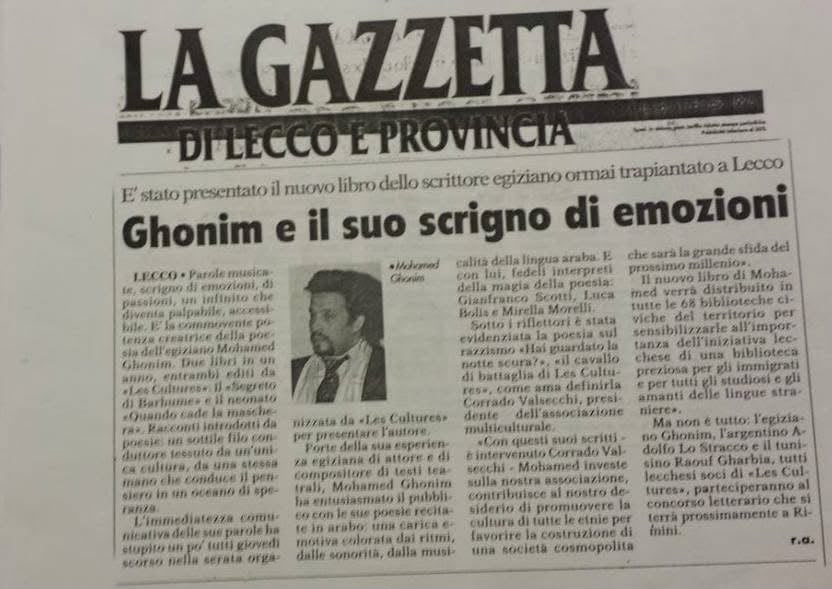
In the original text, Mohamed Ghonim conveys a philosophical concept through his poetic soul, inspiring the forceful language of Il segreto di Barhume. It is a novel in Italian by Mohamed Ghonim, a poet and writer of Egyptian origin who became an Italian citizen. Having enjoyed considerable success, it appeared in two editions from two different Italian publishers and was studied at several universities. Its subtitle is “The story of a strange dialectic between two civilisations”. It was recently published in Arabic in Cairo by Akhbar El Yom.
The plot unfolds in a symbolic space around the relationship between South and North, or East and West, through the secret Barhume carries on his return journey to his father's country. His father, the yellow man, leaves the small village where he met his wife, Barhume's mother, who died when their son was born. Once grown, the son decides to seek his father's country, hoping to find him and live under his protection. Until then he has lived with his maternal grandmother, the sorceress Zendina, whose spells frighten the villagers. They surrender to resignation, passivity, laziness, foolishness, fear and waiting. They circulate rumours and then believe them, amuse themselves and lose themselves in chatter. They live on gifts or alms, begging from tourists or workers on ships docking at the small port nearby. The writer leaves the village and its geography unspecified. It could be one of many villages in the Third World where the previously described afflictions spread, the same traits Ghonim uses to depict his characters.
The novel is set in our modern age, rich in inventions and medical equipment capable of discovering everything inside a person, even lies: an age of technological work requiring formidable minds. On the other side are villagers who inhabit the present only geographically, still walking in the darkness of the past, doing nothing but amusing themselves, spying and begging. This environment favours Arsenico, the barber who spies for the wicked sorceress. He works in the village's central square so that he can overhear everyone's conversations and stories, then “dress and arrange” them before taking them to her.
As usual, there is also the village fool, the outsider or the dishevelled man. He is the most intelligent and knowledgeable person, endowed with culture and experience. He wears the fool's guise when he cannot respond alone to the complexity of events, thereby avoiding accusation. When something changes, this apparently foolish man reveals himself as fully aware and learned. He is Agolungo, the revolutionary intellectual of Ghonim's tale, who takes the boy under his wing and teaches him to read and write without his sorceress grandmother noticing this development, disturbing from her perspective. She wants to teach her grandson magic and leave him the throne that her daughter Zizi cannot inherit. She wanted a male of her own blood; this caused her conflict with Kaiser, her husband, who arrived as a stranger after fleeing the fires of war, probably the Second World War. The sorceress, then in her youth, welcomed and married him, but once she gave birth to a girl, quarrels and separation followed. She gave him the village's only hotel so he could live on its income. Here the novel reveals education as the first step towards breaking through fear, laziness, ignorance and illness, and overcoming the spells through which Zendina rules the village from her mountain hut.
The Grand Master had “built” a school, but nobody sent their children: people preferred indolence and indifference, living on alms and using their children to beg as much as possible from foreigners arriving on ships at the harbour three kilometres away. This was also how the yellow man was received. He arrived on an unforgettable day: Zendina had left her hut to wash her hair for the third time in her life. Each time she did so, an extraordinary event occurred in the village, indeed in the world. The writer says: “The first time, a merciless war broke out, wiping out entire villages and killing countless people, spreading hunger, epidemics and despair. The second time, another war broke out, surpassing the first in its disastrous effects.” This probably refers to the First and Second World Wars. [The supplied Italian text gives the dates “1914–1981” and “1939–1945”.]
That day everyone waits to see what will happen in the village and the world after the sorceress decides to wash her hair a third time. Magic seems to cause the yellow man's arrival: his ship suddenly runs aground near the village. Exhausted, he reaches shore and stays at Kaiser's filthy, disorderly hotel, infested with insects and rats. The sorceress intervenes, making him fall in love with and marry her beautiful daughter Zizi, although she knows that after he has given his seed and departed, her daughter will die at the end of their first year of marriage. At last she brings her plan to fruition.
After Zizi's death, her father Kaiser begins to understand what is happening and that his grandson is inheriting magic from his grandmother. He realises the village will never recover until the sorceress is destroyed. Knowing her power lies in her hair, he begins to plan her destruction.
Near the hut, she tells him that she intends to transfer her power to Barhume so that everyone will submit to his rule. She asks why Kaiser left his cowardly world, which fears only force and knows nothing but eating and reproducing. He attacks her, grips her thin neck and plunges her hair into the fire where she spits and weaves the threads of her magic. He keeps forcing her hair into the flames while saying to Barhume: “She is dead, she is dead… My hair is growing. Barlume, run to your grandfather and do not be afraid of him. He has killed his fear and taken revenge for you, your mother and your father, after the fear of the sorceress killed them.”
A new journey begins in Kaiser's life and in Barhume's. He starts thinking about his village's condition, its lack of commitment and seriousness after being reduced to bondage to hallucinations.
First he must seek his father, recover his papers and discover the secrets of his arrival and departure. His search for his origins begins with Agolungo's help: the papers are in his grandfather Kaiser's hotel. “These are your father's papers… You will find his name, address and country.” But Agolungo warns him that the route is full of danger, especially if the ship approaches the island of the lost. Once past that island, the harbour opposite is where the yellow man lives.
The other shore is often the opposite of our world, a place where a more advanced and enlightened civilisation and highly developed science prosper.
The novel is a variation on the relationship between the world's North and South. We have seen it in Bird from the East by Tawfiq al-Hakim, The Lamp of Umm Hashim by Yahya Haqqi, The Latin Quarter by Suheil Idris, Season of Migration to the North by al-Tayeb Salih, The Return of the Wolf by Ilias El Diriry, Adib by Taha Hussein, The Other Shore and A Single Star on the Horizon by Mohamed Gibriel, and many other works that embody this relationship in one way or another.
Ghonim's variation, however, is different. He brings magic into the relationship between North and South and sees indifference and resignation before hidden forces, represented by Zendina's magic, as the main cause of the South's backwardness. Magic symbolises defeat in the South or Third World and submission to invisible forces deciding people's fate. But paying attention and waking from a long, deep sleep reveals the secret of that backwardness, the secret Barhume keeps among his father's papers.
The novel's form corresponds to its ideas. It is circular, opening with a conversation between a lawyer and a doctor in the northern country to which Barhume has travelled. While the lawyer examines his documents, the doctor does everything possible to save him from the claws of death that grip the ship's passengers as it passes the island of the lost.
As the doctor continues his efforts, the lawyer carefully reads Barhume's papers one by one. They create a new prose structure in which the village's events and the sorceress's story alternate with the earlier account. When the documents end, the structure returns to the initial setting and the lawyer's conversation with the doctor. As Barhume begins to wake, he is drawn towards a dead lagoon thick with mud. This is the man of mud, the magic or spell his grandmother tried to implant before her death to bind him to her dark world.
But Barhume does not surrender; he tries to resist. Ghonim speaks through him as in a nightmare: “I crossed the road and went halfway around the lagoon: I discerned a human presence before me; I could not believe my eyes and rubbed them, but my sight had not deceived me. I approached cautiously. I was close to that presence: it was a man, a living being. Yet the more I looked, the more he seemed a mirage, like a piece of bread in a hungry man's dreams. A human being, yes, but entirely cloaked in mud, even his long beard completely covered; and those eyes! They shone from behind the sludge. It was the man of mud…”
When Dr Sukan says to himself of the sorceress, “She did what she wished with me too!”, two interpretations arise: either he knows her as an educated physician who understands the world around him, including that terrain of backwardness where Zendina symbolises tyranny and evil; or he is Barhume's real father, the yellow man whom Barhume seeks and finally finds after freeing himself from the man of mud. The symbolic dimension becomes clear: on one side stands Dr Sukan, representing scientific development, knowledge, peace and Good; on the other, the man of mud, representing evil, backwardness and obscurantism.
In her preface, however, the Italian writer Claudia Rubbini views the conflict as human: “… It is within each of us, where a man of mud coexists with a white point like a pure dove dozing on a branch.” She reiterates this interpretation when she sees the man of mud as “our baser side, both individual and social, the shadowy zone in which Evil lives, with its entire repertoire of violence, oppression, racism and indifference”, while the white point gives love and hope like the dove of peace. Hers is a philosophical reading of “humanity's universal journey to redeem itself from the damnation of evil and finally rediscover within itself the authentic roots of happiness and freedom”.
She therefore does not emphasise the clash or encounter between two civilisations: one backward, represented by the man of mud, Zendina and the villagers; the other represented by the yellow man, the lawyer and Dr Sukan, despite the author's explicit cover subtitle, “The story of a strange dialectic between two civilisations”.
Yet when Rubbini speaks of the encounter between Western and Eastern cultures, she moves the conflict outside humanity after discovering it within the human soul. She describes Ghonim's book as dealing with “the encounter between Western and Eastern cultures”. For her this is “a journey into memory”, denying a clash between civilisations; indeed, “the dialectical relationship between diverse cultures underlies the evolutionary process that has made our civilisation what it is today”. She seems to waver between reading the work through the human being and through the dialectical relationship between civilisations. This reflects the richness of the work: although a short novel of only 96 pages, it raises many questions. The first need not be “Why a yellow man rather than a white one?” nor the last “Are the people of the South, the Third World or the East generally so savage and backward that, as always, they await an external saviour?” The more dangerous question is where scientific and technological development is heading. We are witnessing surveillance innovations capable of detecting a person's whisper, even inner thoughts, and probing what hearts conceal. How important and dangerous will genetic engineering's role in humanity's future be? We can only repeat Dr Sukan's opening declaration: only the powerful possess the truth.
Returning to Zendina's reasoning, her desire to possess power and bequeath it to Barhume so he may possess the truth, we find power's two-sided coin: science on the front, magic on the reverse. Between them stand either a lazy, backward people like the villagers or an advanced people enamoured of scientific and technological achievements, yet deceived by scientists and rulers who wish to monopolise power and truth. Thus we discover the philosophical concept Ghonim conveys throughout the novel, drawing on his poetic soul to inspire a forceful language in many passages, lending the work greater splendour and an enchanting fascination.
Ahmed Shablul
Poet and literary critic
Source recorded in the archive: Text preserved in the author’s archive